Yes, I think that is the important distinction with the phrase “well in”.
For me, it needs to mean more than simply saying the form has worked out well afterwards. There has to be some evidence that the horse has actually produced a level of performance above the mark it is being asked to race from.
Callisterra is quite a good example to discuss.
At Redcar on 2026-08-22 she finished third over 6f, beaten 2¾ lengths. Racing Post gave the performance an RPR of 63. She was behind Dontlookanyfurther and Don't Stop Movin.
Today she goes into her first handicap off 64, stepping up to just over 7f at Newcastle. Interestingly, her current RPR figure shown on today's card is 68, so there is at least something within the published numbers suggesting that 64 might not represent the absolute ceiling of her ability.
But this is where I think you have to be careful with collateral form.
If the first and second subsequently win, that strengthens the form, but it doesn't automatically upgrade Callisterra by the same amount. Horses improve at different rates, particularly two-year-olds, and what those two achieved afterwards isn't necessarily what Callisterra was capable of producing at Redcar.
What interests me more is whether you can independently find evidence in her own performance.
For example:
What figure did she actually run to on the clock?
Was that figure achieved despite anything unfavourable about pace, track position or conditions?
What does the weight/time calculation suggest?
Does the move from 6f to 7f look likely to improve her, rather than simply assuming further must be better?
And most importantly, can several different measures point towards her being better than 64?
If my own speed/performance figure said 68-70, for example, and another independent method also suggested something similar, then I'd have much more confidence in describing her as potentially well handicapped off 64.
That's really where I'm heading with my own work now. I'm increasingly reluctant to take a single rating at face value. I'm trying to find cases where handicap mark, speed/time performance, race strength and the circumstances of the run all tell roughly the same story.
So I'd agree with you: “well in” shouldn't just be a phrase attached to a horse because something behind or in front of it won next time. Ideally there should be something measurable within the horse's own numbers that says today's mark understates what it has already demonstrated it can do.
All good points
T
tony spencer
These are horses who have previously won a (hopefully) same code Handicap off of a higher OR - I say "hopefully same code" as certain horses can be better on Flat Turf than AW and vice versa and have a completely different range of handicap marks for each code and of course blind database filtering could pick up dual purpose horses who have won handicaps over the NH with it's greater "scale" of Official Ratings.
If you have the means then it is "measurable" and
 MySportsAI
 suggests that overall they are bad bets....that may be strictly true from a "Big Data" perspective but i have met more than a few successful punters who have a flair for "subjectivity" shall we say and have had plenty of skin in the game with this kind of stuff and similar angles. It all comes back to there being more than one way to skin the cat.
Here i've used all Horses who have previously won a Same code Handicap off a 5lb or greater OR
Theoretically they are then "well in"
Although they win around 9.64% of the time off a Random Chance baseline of 10.79% at least since the start of 2018 using UK Flat Turf/AW Handicaps.
Reason for that is that the vast majority will have been declining in form and a large proportion will be older 4yo+ horses who have been relatively exposed.
But there are a few trainers who specialise in this area as not every trainer can be lucky enough to obtain the stock that your Gosden, Haggas, Varian or Andrew Balding typically get as handicappers never mind their blue blood group campaigners.
The following trainers highlighted in blue (with >=300 runs) are all profitable to BFSP with these type of runners (won same code handicap off mark >= 5lbs)
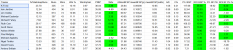
Kevin Frost, Michael Easterby, Richard Fahey, Ruth Carr, Scott Dixon, Paul Midgely & David Evans all perform very well in this area
I've also added in PnL/ROI to BFplace, Industry SP, Evening Before Prices, 7.30AM Prices & 10.30AM Prices.
Of course their record in this sphere should be compared to their "ALL IN" record in Handicaps and i have added that first in the spreadsheet as well as how much these "well in" runners account for their total handicap runcount (for example over 1 in 4 or approx 26% of Kevin Frost's handicappers are theoretically "well in" having won a same code handicap off a 5lb or greater higher mark)
There were only 28 trainers in the UK with >= 300 of these type of runners.
Spreadsheet is down below if anybody wants to download it.
Your example Tony that a horse rated 64 by the BHA but 68-70 by you assumes that both are on the same scale using the same weight for margin allowances. With commerical handicapping & time figures this is seldom the case. Regression studies i have done in the past show that the BHA work to a constant of around 1100 lbs per 60 seconds which give a starting point of around 3-3.5 lbs per length at 5f (depending on pace and actual racetime).
RPR's assume a slightly higher scale but not as high as Timeform who use 1500lbs per 60 seconds in both their handicap and time figures. RPR's would fall somewhere inbetween BHA & Timeform.