

You are using an out of date browser. It may not display this or other websites correctly.
You should upgrade or use an alternative browser.
You should upgrade or use an alternative browser.
Maths/ Physics experts help
- Thread starter Outlander
- Start date

StuartH
Filly
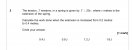
The work done, W, is calculated by integrating the force function over the interval [0.2, 0.4]:Seemingly easy question, but we can’t get this to the same answer as the mark scheme, frustrating my Sons revision for further maths
anyone explain how you do this please.
W = ∫[0.2,0.4] T de.
Substituting the expression for T into the equation:
W = ∫[0.2,0.4] (20e) de.
Integrating the expression, we get:
W = 20∫[0.2,0.4] e de.
Integrating with respect to e, we have:
W = 20[e^2/2] evaluated from 0.2 to 0.4.
W = 20[(0.4^2/2) - (0.2^2/2)].
W = 20[(0.16/2) - (0.04/2)].
W = 20[0.08 - 0.02].
W = 20(0.06).
W = 1.2 joules.
Therefore, the work done when the extension of the spring increases from 0.2 meters to 0.4 meters is 1.2 joules.
have fun
Wow, we thought the mark scheme had it wrong, we couldn’t understand why is wasn’t 1.6
son did all the revision seemed to understand everything, now doing past papers and in meltdown because all the questions have steps he doesn’t know, wish I had your skills StuartH , then maybe I could help him.
Thanks
son did all the revision seemed to understand everything, now doing past papers and in meltdown because all the questions have steps he doesn’t know, wish I had your skills
StuartH , then maybe I could help him.Thanks
StuartH
Filly
You are very welcomeWow, we thought the mark scheme had it wrong, we couldn’t understand why is wasn’t 1.6
son did all the revision seemed to understand everything, now doing past papers and in meltdown because all the questions have steps he doesn’t know, wish I had your skills
Thanks
My Son got A A A Maths/Futher Maths/Chemistry A Levels
Accepted University of Manchester for Mathematics
Absolutely delighted although a shade shocked he didn’t get an A* in Maths.
Much brighter than his Dad who could only manage a B in GCSE. Maths
Some shocking results from some of his friends, think it was tough grading this year. A lot of disappointed kids faces today at the college, you could see what it meant to them.
I lot of hard work involved from these kids though and I feel for those that didn’t make it, can tell you it damn near killed us all getting there.

Accepted University of Manchester for Mathematics
Absolutely delighted although a shade shocked he didn’t get an A* in Maths.
Much brighter than his Dad who could only manage a B in GCSE. Maths
Some shocking results from some of his friends, think it was tough grading this year. A lot of disappointed kids faces today at the college, you could see what it meant to them.
I lot of hard work involved from these kids though and I feel for those that didn’t make it, can tell you it damn near killed us all getting there.

ThanksWow - congratulations to your son - brilliant results, you should be very proud of him !!
 dave58 we are very proud , he’s took a few knocks watched all his friends get jobs over the summer via parents and people they know and he was rejected from everywhere, he was even rejected by Tescos.
He works really hard and nobody wanted him. Nobody even interviewed him.
I hope so, as a parent you worry about everything, but I know he will get the degree , not sure if that guarantees you success in life nowadays, but fingers crossed.He'll have fun at university and once he's finished his degree I bet people will be falling over each other to offer him a job.

ARAZI91
Mare
Can be reduced to a simpler version O Outlander (which in maths/physics helps the layman understand better) - First of all you use the old definition found by French mathematician Gaspard-Gustave Coriolis in the 1800's when working on steam engines that "work is equal to the product of force and displacement" which can be reduced to "Work = Force × Distance"Seemingly easy question, but we can’t get this to the same answer as the mark scheme, frustrating my Sons revision for further maths
anyone explain how you do this please.
So if the equation is 20e where e = metres of extension then you can calculate the initial and final tension for the extension given in the question.
In this N= Newtons
Initial extension (e1) = 0.2 meters
Initial tension (T1) = 20 × 0.2 = 4 Newtons
Final extension (e2) = 0.4 meters
Final tension (T2) = 20 × 0.4 = 8 Newtons
Then you can use that to calculate the delta in tension and also use it to calculate "work done"
Tension Delta = (ΔT) so (ΔT)= (T2 - T1) = (8 N - 4 N) = 4 N
then average tension under the tension change = (T1 + T2) / 2 = (4 N + 8 N) / 2 = 6 N. (This is the "Force" part)
The delta moved during the extension change is Δe = e2 - e1 = 0.4 m - 0.2 m = 0.2 m. (This is the "Distance" part)
Then to calculate actual "work done" because Work = Force x Distance , your "Force" is just the average Tension (6 N) from above
and your "Distance" is just the 0.2m again from above
6 x 0.2 or 6N x 0.2m = 1.2 joules
Last edited:
ThanksCan be reduced to a simpler version O Outlander (which in maths/physics helps the layman understand better) - First of all you use the old definition found by French mathematician Gaspard-Gustave Coriolis in the 1800's when working on steam engines that "work is equal to the product of force and displacement" which can be reduced to "Work = Force × Distance"
So if the equation is 20e where e = metres of extension then you can calculate the initial and final tension for the extension given in the question.
In this N= Newtons
Initial extension (e1) = 0.2 meters
Initial tension (T1) = 20 × 0.2 = 4 Newtons
Final extension (e2) = 0.4 meters
Final tension (T2) = 20 × 0.4 = 8 Newtons
Then you can use that to calculate the delta in tension and also use it to calculate "work done"
Tension Delta = (ΔT) so (ΔT)= (T2 - T1) = (8 N - 4 N) = 4 N
then average tension under the tension change = (T1 + T2) / 2 = (4 N + 8 N) / 2 = 6 N. (This is the "Force" part)
The delta moved during the extension change is Δe = e2 - e1 = 0.4 m - 0.2 m = 0.2 m. (This is the "Distance" part)
Then to calculate actual "work done" because Work = Force x Distance , your "Force" is just the average Tension (6 N) from above
and your "Distance" is just the 0.2m again from above
6 x 0.2 or 6N x 0.2m = 1.2 joules
 ARAZI91 , he off to Manchester Uni next month, will show him this also, I did understand it a bit more myself reading this.
Mechanics element his weakest and can let him down a bit.