• The issue has been fixed and hopefully you can post screen shots again
  • Hi Guest Just in case you were not aware I wanted to highlight that you can now get a free 7 day trial of Horseracebase here.
    We have a lot of members who are existing users of Horseracebase so help is always available if needed, as well as dedicated section of the fourm here.
    Best Wishes
    AR

Handicap Class Droppers

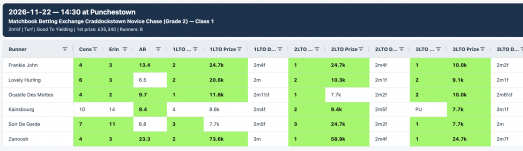
Punchestown 2:30
Screenshot 2026-11-22 at 11.33.44.png

Again, not much in the way of isolation here though Lovely Hurling holds a 15 lb advantage at the weights today over the Mullins 2nd fav. That is due to being runner up in all last 4 starts to higher rated horse than him and this field. Jumping has been noted several times as not fluent but this really seems like a drop in class and opposition today. The danger could be his own stablemate Zanoosh switching from an excellent hurdle season over mainly longer distances to fences today. Seems a strange move to me, as surely they would go a slower pace over 2m 4f or 3m providing less of a test on a novice's jumping? Nevertheless he is actually dropping in class of race today.
The selection on the evidence would have to be Lovely Hurling but not a confident bet with Zanoosh in the race.

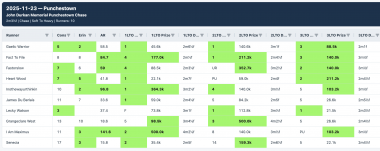
Punchestown 3:00
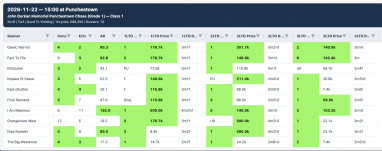
Screenshot 2026-11-22 at 11.45.09.pngScreenshot 2026-11-22 at 11.48.12.png

I thought I'd show the comparison between this year's overview and last year's for the John Durkan.
It's difficult to see why Gaelic Warrior will not win this again other than through ill fortune or lack of fitness. So he has to be the selection.
Just a question as to if 4/7 represents a fair bet?
I've seen worse but if you compare this situation to say Grey Dawning yesterday, who has the tougher task on paper?
You'd have to argue that 11/10 for Grey Dawning first time out was far better value than Gaelic Warrior and I'll just watch the race.

Cork 2:19
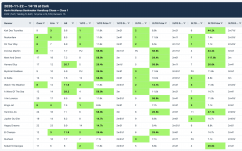
Screenshot 2026-11-22 at 11.56.14.png

Looking through the probables I'd have to pick Rockonliam with his handicap form so far. The horse that beat him last time was an ex Mullins runner that seemed to be a surprise winner. But he went off just 14/1 in the big race at Cheltenham last weekend and wasn't disgraced by any means. Outside of the probables, the class dropping Al Kalila looks likely to get involved also.
Selection : Rockonliam
 
Cork 3:19 Having watched Theanniversary Man win very easily a few days ago and given I can only see Lanzhou and St Lawrence's Well as the only serious opposition I'm going to back this course win under the penalty but carrying 3lb less under the same rider.

Cork 3:49 I'm making a 3 horse book on King Of The Greys, Jackmoon and The Rebel Fox.

3 most consistent choices have proved woeful so far.
Perhaps it is just down to pure chance which of the 3 wins.
 
I think I was right the other day about the whole narrowing the field from the first 6 in the betting.

Stats show well over 80% of winners come from that area.

Creating a sub group within that of 3 but often more runners based on the consistency totals is not increasing the 80% probability to any significant degree if at all.

And there is no rhyme or reason within that sub group as to who the winner will be.

So it's a meaningless statistic in the context of the first 6 in the betting.

I think one is better off just looking at the 6 or 7 horses involved in the top level filter and finding ways to spot likely winners. There is no magic key to isolating winners from the sub groups on anything but a very occasional but still precarious basis.

I'm certainly not going to waste time anymore going through races on a consistency only basis again. Yes it traps winners but as so many have discovered since VDW first put pen to paper, picking the one to be on is not easy to predict.
 
I don't have large number sets to present, Tufnel Tufnel, but my strong impression is that looking at consistency not on the counting of places basis but on the Buckbe basis is likely to prove the more accurate. And with either, don't (as I have for too long) leave the fourth term (probability) of the VDW equation out of consideration. I think it is the explanation for one or two of the more difficult VDW examples (Little Owl 2 for example) and it certainly serves as a safety net quite often in current races, today's 11.25 and 1.25 Lingfield being cases in point.
 
I don't have large number sets to present, Tufnel Tufnel, but my strong impression is that looking at consistency not on the counting of places basis but on the Buckbe basis is likely to prove the more accurate. And with either, don't (as I have for too long) leave the fourth term (probability) of the VDW equation out of consideration. I think it is the explanation for one or two of the more difficult VDW examples (Little Owl 2 for example) and it certainly serves as a safety net quite often in current races, today's 11.25 and 1.25 Lingfield being cases in point.
Well I'm not sure I still have completely understood the Buckbe example on the consistency front. Though I get the the idea of not letting a downturn through the form rating process. Righthand Man's 2 previous races had been wins, but the 3rd last run, albeit the last run of the previous season was out of the frame in a better race than those 2 winning races.

Also, I would say I'm not sure what your definition of the probability factor actually is. Obviously it is something you have clear in your mind and it is important, but as it stands I don't know how one is measuring the probability factor other than it being linked to odds.
 
Tufnel Tufnel

I think it is clear that VDW used consistency in at least two ways, the first as per the 07/03/81 article, ie "the three most consistent from the forecast" which the various *s in the tables suggest were noted by adding the last three placings of those in the first five/six of the forecast. But on that basis, if we take the race won by Catch Phrase, in which VDW said Buckbe was the "class/form" horse, all must have been consistent as there were only three runners.

Yet having referred to the race in an article dated 26/01/85, less than three months later VDW wrote that five out of six races he discussed from 05/01/85 were "won by CONSISTENT horses" (his capitalisation) and went on to say that that was "one of the factors against Buckbe which I mentioned last time I wrote." That suggests to me that VDW was referring to a second way of thinking about consistency, on which Buckbe did not qualify as consistent.

To me that makes sense, because the placings totals meaning, while more or less straightforward, is necessarily often not just dependent on one horse. Any horse with a last three race placing total of 3, 4 or 5 is, on that basis, a consistent horse. But as we see from the 07/03/81 and 13/04/85 articles, one can have consistent horses of up to 9 (and indeed in other races higher numbers than that). Then, whether a give horse gets a * as consistent depends partly on its last three race placings total but also on others. A horse might have a total of 6 and not qualify for a * as consistent, but with one double that does, because of others' numbers on that metric. On any basis except a strict interpretation of last three race placings totals, it is hard to see much logic in saying a horse rated 6 is less consistent that one rated 8 or 9 or even double figures.

The reference to Buckbe suggests to me that VDWs second usage was specific to each horse, not in any way dependent on the numbers for any other runners, and not arbitrarily limited to three. My current view is the one I have expressed before, that any "form" horse is consistent on this second usage if on VDW's way of rating forum status each of its last three runs was a "form" run (and in some cases, mainly when the last three contained a failure to complete, three of its last four were "form" runs). That, to me, has the advantage of being horse-specific and not sometimes being determined by an arbitrary number of qualifiers in a race.

As to probability, I am not absolutely sure but like you I can see no more likely explanation than that it means odds. VDW isn't explicit on the point and I guess the only way to find a working approach is by seeing what he did in practice in his examples, just as one has to do in my judgement for issues such as position in the ability ratings and finishing places rankings.
 
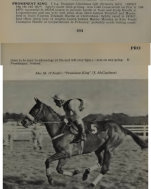
Thanks. I think the 76/77 season.
Only ran four times in 76/77 and rated an end of season 156 which would have came from the run in the Erin
No big essay or anything as usually only the top horses get that treatment (165+) in these annuals
but did warrant a photograph

Got Chat GPT to join the images together as PK's entry was on different pages

Prominent_King_joined.png
 
Tufnel Tufnel

I think it is clear that VDW used consistency in at least two ways, the first as per the 07/03/81 article, ie "the three most consistent from the forecast" which the various *s in the tables suggest were noted by adding the last three placings of those in the first five/six of the forecast. But on that basis, if we take the race won by Catch Phrase, in which VDW said Buckbe was the "class/form" horse, all must have been consistent as there were only three runners.

Yet having referred to the race in an article dated 26/01/85, less than three months later VDW wrote that five out of six races he discussed from 05/01/85 were "won by CONSISTENT horses" (his capitalisation) and went on to say that that was "one of the factors against Buckbe which I mentioned last time I wrote." That suggests to me that VDW was referring to a second way of thinking about consistency, on which Buckbe did not qualify as consistent.

To me that makes sense, because the placings totals meaning, while more or less straightforward, is necessarily often not just dependent on one horse. Any horse with a last three race placing total of 3, 4 or 5 is, on that basis, a consistent horse. But as we see from the 07/03/81 and 13/04/85 articles, one can have consistent horses of up to 9 (and indeed in other races higher numbers than that). Then, whether a give horse gets a * as consistent depends partly on its last three race placings total but also on others. A horse might have a total of 6 and not qualify for a * as consistent, but with one double that does, because of others' numbers on that metric. On any basis except a strict interpretation of last three race placings totals, it is hard to see much logic in saying a horse rated 6 is less consistent that one rated 8 or 9 or even double figures.

The reference to Buckbe suggests to me that VDWs second usage was specific to each horse, not in any way dependent on the numbers for any other runners, and not arbitrarily limited to three. My current view is the one I have expressed before, that any "form" horse is consistent on this second usage if on VDW's way of rating forum status each of its last three runs was a "form" run (and in some cases, mainly when the last three contained a failure to complete, three of its last four were "form" runs). That, to me, has the advantage of being horse-specific and not sometimes being determined by an arbitrary number of qualifiers in a race.

As to probability, I am not absolutely sure but like you I can see no more likely explanation than that it means odds. VDW isn't explicit on the point and I guess the only way to find a working approach is by seeing what he did in practice in his examples, just as one has to do in my judgement for issues such as position in the ability ratings and finishing places rankings.
But if I go back to Buckbe, and even allowing for non completed starts the issue arises that I don't see why this particular runner is classed as inconsistent.

Taking the fall out and going back to the 4th last run, which was the seasonal debut the horse won a class 18 race. Then went up a long way to a class 99 race but ran 5th down the field. So not a better performance than the win but surely not a worse performance in view of the class lift?

Next was the drop to a class 30 race where the horse was 5/2 made headway at the 12th and then fell at the 14th. But it's an non completion and the horse was clearly not noted as beaten at the time of the fall.

Then went up in class to a 54 and won, which was clearly a better performance than any of the 3 previous runs.

Why is that profile classed as inconsistent form?

VDW referred to Catch Phrase as 2nd on class/form. A horse who fell LTO, pulled up 2nd LTO, ran 6th 3rd LTO (previous season), 6th 4th LTO, Fell 5th LTO and won 6th LTO. The 3rd LTO was in a 6th in class 183. But the 2 subsequent runs don't seem to suggest any improvement there.
Perhaps it was a typo and meant to say the 2nd on class?
 
Only ran four times in 76/77 and rated an end of season 156 which would have came from the run in the Erin
No big essay or anything as usually only the top horses get that treatment (165+) in these annuals
but did warrant a photograph

Got Chat GPT to join the images together as PK's entry was on different pages

View attachment 173773
Thanks ARAZI91 ARAZI91 much appreciated. That would mean P King was rated 13 lb inferior to Beacon Light at the end of the 76/77 season.
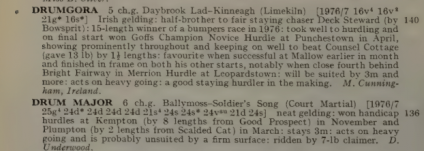
And if PK had to give Drumgora 19 lb in the Ticknock Handicap then that horse was rated roughly 137 on Timeform.
Given that Decent Fellow had a 6 lb penalty when he beat Drumgora then DF was rated around 148 at that time.

And so we come to the situation where P King was receiving just 4 lb from a Beacon Light who was supposedly rated around 12 lb superior in the Erin.

Which is why people were somewhat dumfounded by VDW's view that BL was well out of it and also later that readers didn't need his ratings that he compiled, they could use the ones available in the market place. And that's misleading for him to say that as clearly the market place and sporting papers had Beacon Light with pounds in hand at the weight for the race. There is no record of ratings having Beacon Light rated on a handicap basis as below Prominent King.
Drumgora.png

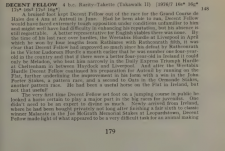
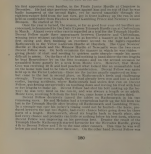
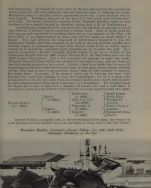
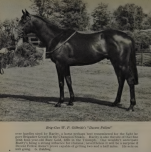
Despite his rating Timeform must have thought Decent Fellow was of interest to go the full scale essay treatment and several pics

DF1.png
DF2.pngDF3.pngDF4.png
 
"Which is why people were somewhat dumfounded by VDW's view that BL was well out of it and also later that readers didn't need his ratings that he compiled, they could use the ones available in the market place. And that's misleading for him to say that as clearly the market place and sporting papers had Beacon Light with pounds in hand at the weight for the race."

But there are ratings and ratings. The methods VDW used to rate "all five horses" were not the same, or used for the same purposes, as the ratings shown in the right hand columns of the four 07/03/81 tables, and it was to those VDW was referring when he wrote, and indeed illustrated in his 13/04/85 article, that one could use any ratings for that purpose.

With respect, Tufnel Tufnel, you are making the same mistake as the posters with whom I have discussed the Roushayd example. It is perfectly possible to construct a case as to why, for example, Beacon Light was the most likely winner of the 1978 Erin and Ile De Chypre the most likely winner of the 1988 Old Newton Cup, and such cases seem both logical and compelling. But that is beside the point. With the VDW puzzle, we have to try to envision how he saw things. He wrote that Beacon Light as "well out of it" and Ile De Chypre was "no match for Roushayd". The task, if one wants to understand VDW's method, is to work out precisely why. And exactly the same applies to Buckbe, Catch Phrase etc.

If VDW really did achieve the kind of success rate he claimed, and as we all know that was never proven, it is unlikely he did so by using what might be described as well-established ways of trying to find winners.
 
View attachment 173774

Despite his rating Timeform must have thought Decent Fellow was of interest to go the full scale essay treatment and several pics

View attachment 173775
View attachment 173776View attachment 173777View attachment 173778
Thanks again ARAZI91 ARAZI91

That's interesting stuff and my estimates for the likely Timeform ratings of both Decent Fellow and Drumgora were almost spot on. Obviously they will differ from the official handicappers view at the time, but it looks like Drumgora was probably dropped a few poundsin view of his first few runs of the 77/78 season. And of course Decent Fellow was carrying a 6lb penalty when beating Drumgora which I accounted for in my calculations.

What is really interesting is that Timeform had Drumgora down as a staying hurdler and yet his best 2 runs in the next season were when 3rd and 1st at 2m in the races involving Decent Fellow and P King.

If VDW had followed more of Marvex's advice and his main edge of making his own handicap ratings, then perhaps VDW had raised Drumgora for his 3rd to Decent Fellow who was carrying a 6 lb penalty?

So when Prominent King was giving Drumgora 19 lbs it was PK giving 19 lbs to a horse rated more than 140.

Still comes back to why would Beacon Light failing by just a length to give 4 lbs to horse rated around 175 be seen as reason to put BL "well out of it" though?
 
"Which is why people were somewhat dumfounded by VDW's view that BL was well out of it and also later that readers didn't need his ratings that he compiled, they could use the ones available in the market place. And that's misleading for him to say that as clearly the market place and sporting papers had Beacon Light with pounds in hand at the weight for the race."

But there are ratings and ratings. The methods VDW used to rate "all five horses" were not the same, or used for the same purposes, as the ratings shown in the right hand columns of the four 07/03/81 tables, and it was to those VDW was referring when he wrote, and indeed illustrated in his 13/04/85 article, that one could use any ratings for that purpose.

With respect, Tufnel Tufnel, you are making the same mistake as the posters with whom I have discussed the Roushayd example. It is perfectly possible to construct a case as to why, for example, Beacon Light was the most likely winner of the 1978 Erin and Ile De Chypre the most likely winner of the 1988 Old Newton Cup, and such cases seem both logical and compelling. But that is beside the point. With the VDW puzzle, we have to try to envision how he saw things. He wrote that Beacon Light as "well out of it" and Ile De Chypre was "no match for Roushayd". The task, if one wants to understand VDW's method, is to work out precisely why. And exactly the same applies to Buckbe, Catch Phrase etc.

If VDW really did achieve the kind of success rate he claimed, and as we all know that was never proven, it is unlikely he did so by using what might be described as well-established ways of trying to find winners.
But the difference is I have no issues with Roushayd being the class/form horse in that race. At that time he had clearly achieved more than Ile De Chypre had even allowing for the fact IDC would have won at Ascot without veering off near the finish.

The only way Beacon Light is well out of it for the Erin is if he is rated as a non form horse. I don't really see the logic in failing to give 4 lbs by a mere length to a horse not only rated officially around 7 lbs superior, but who had won it's last 3 completed starts and carrying big weights in signficant handicaps as reason to class it a non form horse.

He also said BL was out of it on both methods of "rating". If one method was form status and the other was class then again, how can that be given the ARs of those involved?

If the other method of rating was class, then it had to be on a class of race and opposition basis and we all know the numbers on that. And if those numbers are significant, mainly in respect of Drumgora having dropped in class from a 3rd in a race worth more than the Erin itself, that doesn't ring true given that the other day I asked the question as to what if Drumgora had not been in the Ticknock handicap and you suggested it would have made no difference to Prominent King's chance.

Whilst I agree with that in so far as ultimately Prominent King would still have won the Erin, VDW could not have rated the performance in the Ticknock as anything special without Drumgora's presence in it. Otherwise why look at the opposition at all?

I realise you are saying PK would have been the winner in the Ticknock and therefore not subject to the same key horse scrutiny, but it would have been a victory in a class 6 race and nothing more without Drumgora. And even Mr Kildare had achieved better form than that in his last run.

So I find there are inconsistencies in the logic for some of the means used to rate the form status. If Mr Kildare's last win was downgraded as having been "against not much opposition" then Prominent King winning an even lesser value race without Drumgora in it would surely have fallen into the same basket?
 
It is a matter of process, Tufnel Tufnel. Had Drumgora not run and Prominent King had won easily, it would still have been a "form " run and PK a "form" horse. When, looking at the Erin field, we assume VDW saw Prominent King as the class/form horse as in part a result of that, there then (and only then) arises the question of was he one to back or leave (the <20%/>80% question).

Prominent King was certainly not viewed by VDW as a strong bet, as otherwise the description would have been something on the lines of "outstanding bet" or "certainty", and one of the reasons for that is obvious - his ability rating rank position. We don't know for sure whether he was even a bet; VDW didn't say.

In thinking about whether PK was a class/form horse strong enough to back, would it have made any difference if PK had won lto in a race without Drumgora? I don't know, but doubt it. If Lee was correct in thinking that some of VDW's selections came from lists, maybe PK was one such, noted when running well in the 1977 Erin as a 5yo. VDW would then have noted what PK did subsequently, maybe concluding that the race previous to the 1978 Erin was a prep one, in which case the presence or absence of Drumgora was of no great moment. But we are now well and truly in the land of conjecture, and I see it as more profitable to stay with what actually happened and what VDW said about it.

".... would surely have fallen into the same basket?"

But what basket? VDW clearly regarded Mr Kildare as a "form" horse. The quality of the others engaged in his last race prior to the Erin made no difference to that, his ability rating or his status as a consistent horse, either on the place-counting basis or the Buckbe one.
 
Last edited:
Back
Top