What your describing here
O
Outlander was once seen as "state of the art" in the syndicate betting world but has now become par for the course.
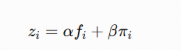
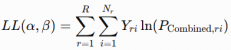
The mathematics at best are high school level and involve combining a) the logit transformed probabilities of a fundamental model with b) the betting public's estimation or "market" (again transformed as logits). Optimising both for the correct weighting is usually done by maximising the log likelihood function over a set of past and also hold out races. Benter discusses the process in his seminal paper but the origins of the idea is as old as the hills and has it's roots in physics and statistical mechanics and is known as the "softmax function" - combining two or more probability distributions is nothing new.
Was probably an elementary step for Benter given that the choice of model by those HK pioneers was logistic regression, later upgrading to probit type regression. The mainly Bayesian "state space" models used mostly nowadays by syndicates would make the Benter's/Woods & Bob Moore type models seem very rudimentary. That's not to say Benter was not a genius - it's rumoured that his latter probit models in the early 90's in HK had 14 different "jockey" auxiallary models each with up to 15 variables. I also have a rare Benter paper where he puts forward a very elegant solution to modelling "distance preferance" in thoroughbreds using a least-squares parabolic curve fitting method involving Hill-Keller's "optimal running" theory and the use of mathematical Tack Points and Biezer Curves.
The basic mathematics
logit transformation
View attachment 172111
then becomes
View attachment 172112
combined using the exponential distribution and normalised
View attachment 172113
Log Likelihood function then maximised on past/hold out races
at that time the model of choice was logistic regression where 1 = winner and 0 = otherwise
View attachment 172114
Benter moving to Probit meant that he could condition on say "normalised finishing position" or "target speed rating" rather than the binary outcome of winner/otherwise.
some rare(ish) Benter
View attachment 172115
View attachment 172116
View attachment 172117


DuckandDive probably puts it better than I can.