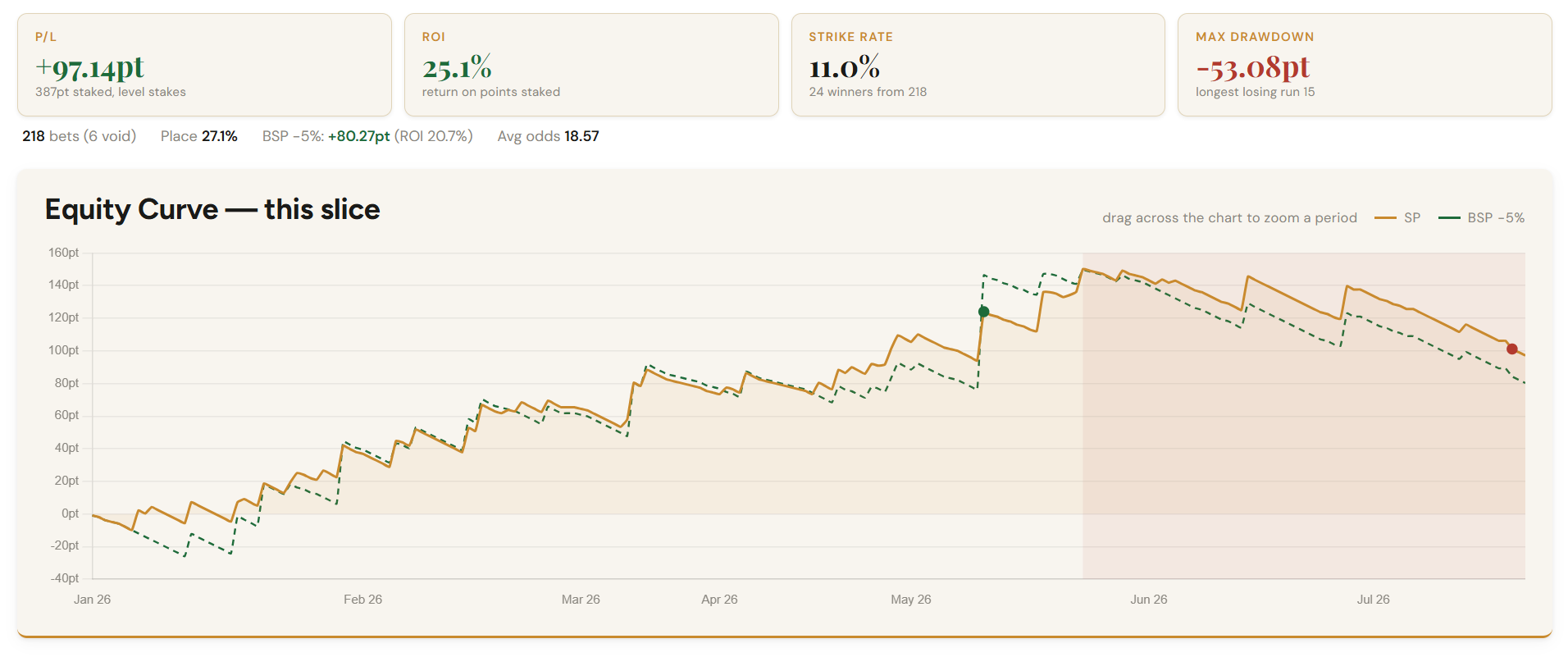
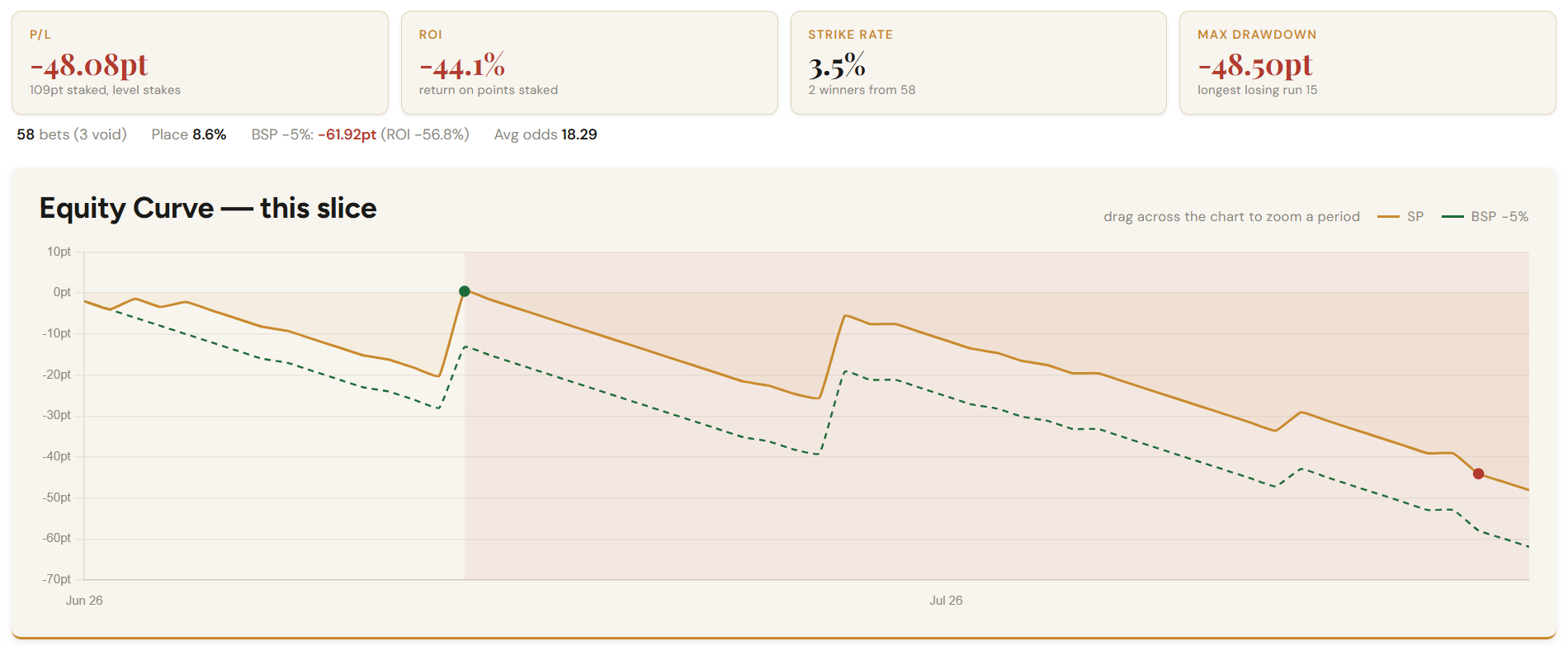
i review all my races like this
Overall assessment
| Area | Assessment |
|---|
| General race-shape analysis | Good |
| Recognition of the high/near-side possibility | Good |
| Early-position forecast | Poor to mixed |
| Finishing-strength analysis | Very good |
| Main contender assessment | Good |
| Negative runner assessment | Very good |
| Practical betting outcome at SP | No bets |
| Overall report score | 7.5/10 |
The strongest success: French Affair
The report identified French Affair as having:
- A front-quarter projection.
- FinishStrength rank 3.
- A top-three late rating.
- One of the best pace-and-finish combinations in the race.
She won at 14/1.
The actual run demonstrated that the
finishing-strength assessment was excellent, although the early-position projection was completely wrong:
- She dwelt at the start.
- Raced near side in the rear.
- Was short of room.
- Made progress over one furlong out.
- Led inside the final 110 yards.
- Kept on to win.
The report concluded:
“Interesting setup horse but insufficient model support. Require Betfair 21.50 or bigger.”
Her returned SP was 14/1, equivalent to decimal 15.00. Therefore, she did not meet the required price.
Assessment
This was still a major analytical success. The report identified the winner’s finishing ability and recognised her as a legitimate contender. The mistake was requiring too much compensation for the poor AbilityPlus and trainer-model rankings.
Her
FinishStrength rank 3 proved more important than trainer-model rank 25 in this particular race.
Under The Twilight — second
The report described Under The Twilight as:
- AbilityPlus rank 5.
- FinishStrength rank 2.
- A strong finisher.
- Tactically vulnerable because of her expected last-place early position.
That was a very accurate description of her strengths and risks.
She raced towards the rear against the near rail, progressed two furlongs out and disputed the lead inside the final 110 yards.
The report was correct that she would be held up, but it overestimated how damaging that would be. The near-side group provided a clean enough route for her finishing strength to become decisive.
She returned at 13/2, decimal 7.50, considerably shorter than the quoted PDF price of 10.50.
Assessment
Excellent ability and finishing analysis. The position risk was real, but it was given too much weight.
Expert Agent — sixth
Expert Agent was the report’s best value selection because he had:
- AbilityPlus rank 1.
- Trainer-model rank 3.
- FinishStrength rank 5.
- Useful late strength.
The projected problem was an early rank of 25/26.
That is approximately how he ran:
- Raced near side.
- Held up in the rear.
- Progressed against the near rail.
- Kept on late.
- Finished sixth, only around 2.50 lengths behind the winner.
His performance supported the model assessment, but he was never ideally placed to win.
The required price was Betfair 34.00, while his 22/1 SP was decimal 23.00.
Assessment
The horse analysis was good, and the minimum price correctly protected against the positional risk. He was not a bet at SP.
Sir Garfield — eighth
Sir Garfield was called the most likely winner because of:
- AbilityPlus rank 2.
- A projected front-quarter position.
- A position within the expected strong low-side group.
However, the report also warned:
- FinishStrength rank 16.
- Likely pace–late risk.
- Possibility of racing too freely.
- Potential to weaken after an early battle.
That concern was exactly what happened. He raced prominently but had no extra inside the final furlong.
He returned at 9/1, decimal 10.00, below the required Betfair price of 15.00.
Assessment
The “most likely winner” label was too strong, but the report correctly identified why he could be beaten and correctly refused the shorter price.
Other shortlisted runners
Calling A Star — twenty-second
Calling A Star was expected to race in the front quarter but was always behind.
The report’s concerns proved more important than the trainer-model rank:
- AbilityPlus rank 11.
- FinishStrength rank 17.
- Pace risk.
- Trainer-form caution.
At 10/1, decimal 11.00, he was below the required 16.50.
Assessment: Poor positional forecast, but correct price restraint.
Mythical Composer — twenty-third
He dwelt and was always behind.
The report respected his AbilityPlus rank 4 but highlighted weaker trainer-model and finishing evidence. Those concerns were justified.
His 25/1 SP was decimal 26.00, below the required 32.50.
Assessment: Correctly treated cautiously.
Rory Rocket — nineteenth
The report warned that Rory Rocket could:
- Miss the break.
- Race too freely.
- Be held up.
- Encounter traffic.
He was slowly away, raced towards the rear and never became involved.
His strong FinishStrength rank could not compensate for his poor position and low AbilityPlus rank.
Assessment: The risk assessment was excellent, but the “main late danger” description was too positive.
Winchurch — fifteenth
Winchurch was prominent but weakened over one furlong out.
Despite his FinishStrength rank 4, he failed to finish as predicted. His 40/1 SP was decimal 41.00, below the required 46.00.
Assessment: A disappointing run and a weaker part of the shortlist.
Negatives that were correctly identified
The opposition section performed particularly well.
Supreme King — seventh
The report opposed him at the short price because of:
- Trainer-model rank 23.
- Unfavourable supporting evidence.
- Potential positioning problems.
- Free-going tendency.
He started favourite at 11/2, raced close to the leaders and had no extra late.
Correct opposition.
Kanishka — sixteenth
He dwelt, raced in the rear and was never dangerous.
The report highlighted weak AbilityPlus, trainer-model and finishing rankings.
Correct opposition.
Velvet Rhythm — twenty-fourth
She raced prominently but weakened two furlongs out.
Correct pace-runner opposition.
Fresh Fade — eighteenth
The report rejected the enormous apparent value because he ranked:
- 24th AbilityPlus.
- 26th trainer model.
- Last for finishing strength.
He was always behind.
Excellent rejection of misleading headline value.
What happened to the predicted race shape?
The report expected front-half runners to hold a major historical advantage, but the first two came from the rear:
- French Affair — rear.
- Under The Twilight — towards rear.
- Wreck It Ryley — prominent.
- Mae Amor — pressed the leader.
- Cashbox — prominent.
This was not a complete pace collapse because prominent runners filled third, fourth and fifth. However, the strongest finishers in the near-side group were able to come over the top late.
The report correctly anticipated:
- A divided field.
- Pace spread across the course.
- The possibility that the winning side would matter more than the raw stall number.
- A possible high-draw advantage.
But it incorrectly thought the low-to-middle pace group might prove strongest. The decisive race developed on the
middle-to-high, near-side part of the course.
The first six came from stalls:
That is a very clear indication that the near-side group dominated the finish.
The runners the report missed
Wreck It Ryley — third at 28/1
He raced prominently in the centre and briefly led late. He fitted the report’s preferred practical profile:
- Useful position.
- Conserved energy.
- Stayed involved late.
He was not discussed.
Mae Amor — fourth at 50/1
She pressed the leader on the near side and led overall before being caught late. She also fitted the favourable front-half profile and was not discussed.
Cashbox — fifth at 18/1
Cashbox was recognised as a possible pace contributor but was not examined as a contender. She raced prominently on the dominant near side and stayed competitive until the final 110 yards.
These three runners suggest the final shortlist was too heavily driven by model rankings and not enough by the
combination of racing side, likely position and sustainability.
Price assessment
At SP, none of the report’s quoted minimum prices were reached:
| Horse | Required Betfair price | SP decimal | Bet at SP? | Result |
|---|
| Expert Agent | 34.00 | 23.00 | No | 6th |
| Sir Garfield | 15.00 | 10.00 | No | 8th |
| Calling A Star | 16.50 | 11.00 | No | 22nd |
| French Affair | 21.50 | 15.00 | No | 1st |
| Mythical Composer | 32.50 | 26.00 | No | 23rd |
| Rory Rocket | 26.00 | 17.00 | No | 19th |
| Winchurch | 46.00 | 41.00 | No | 15th |
Following the minimum prices strictly at SP would therefore have resulted in
no bets and no loss.
However, it also meant missing the 14/1 winner.
Main lesson from this race
This result suggests that in very large-field sprints, the report should give slightly more weight to horses with a
top finishing-strength rating combined with a plausible race-side advantage, even when their principal model ranks are weaker.
French Affair had:
- FinishStrength rank 3.
- Top-three late ability.
- A high/middle draw.
- A potentially favourable near-side route.
- A double-figure price.
Requiring Betfair 21.50 was probably too cautious. A more practical minimum might have been around
Betfair 16.00–18.00. She returned at decimal 15.00, so she would still have been borderline at SP but may have qualified at an earlier exchange price.
Final judgement
This was a
strong report with no practical betting return.
The report:
- Included the winner as an interesting contender.
- Correctly identified her excellent finishing profile.
- Correctly identified the runner-up as another leading finisher.
- Accurately predicted Expert Agent’s rear-position problem.
- Correctly forecast Sir Garfield’s late vulnerability.
- Successfully opposed Supreme King, Kanishka, Velvet Rhythm and Fresh Fade.
- Recognised that the field could split and one side could dominate.
Its weaknesses were:
- Giving excessive weight to historical early-position percentages.
- Underestimating the near-side advantage.
- Setting French Affair’s minimum price too high.
- Missing Wreck It Ryley, Mae Amor and Cashbox.
- Treating Rory Rocket as a principal late danger despite multiple severe risks.
Overall: 7.5/10 for the report, but no winning bet under the stated price rules. The analysis found the winner’s key strength; the value calculation prevented the bet.